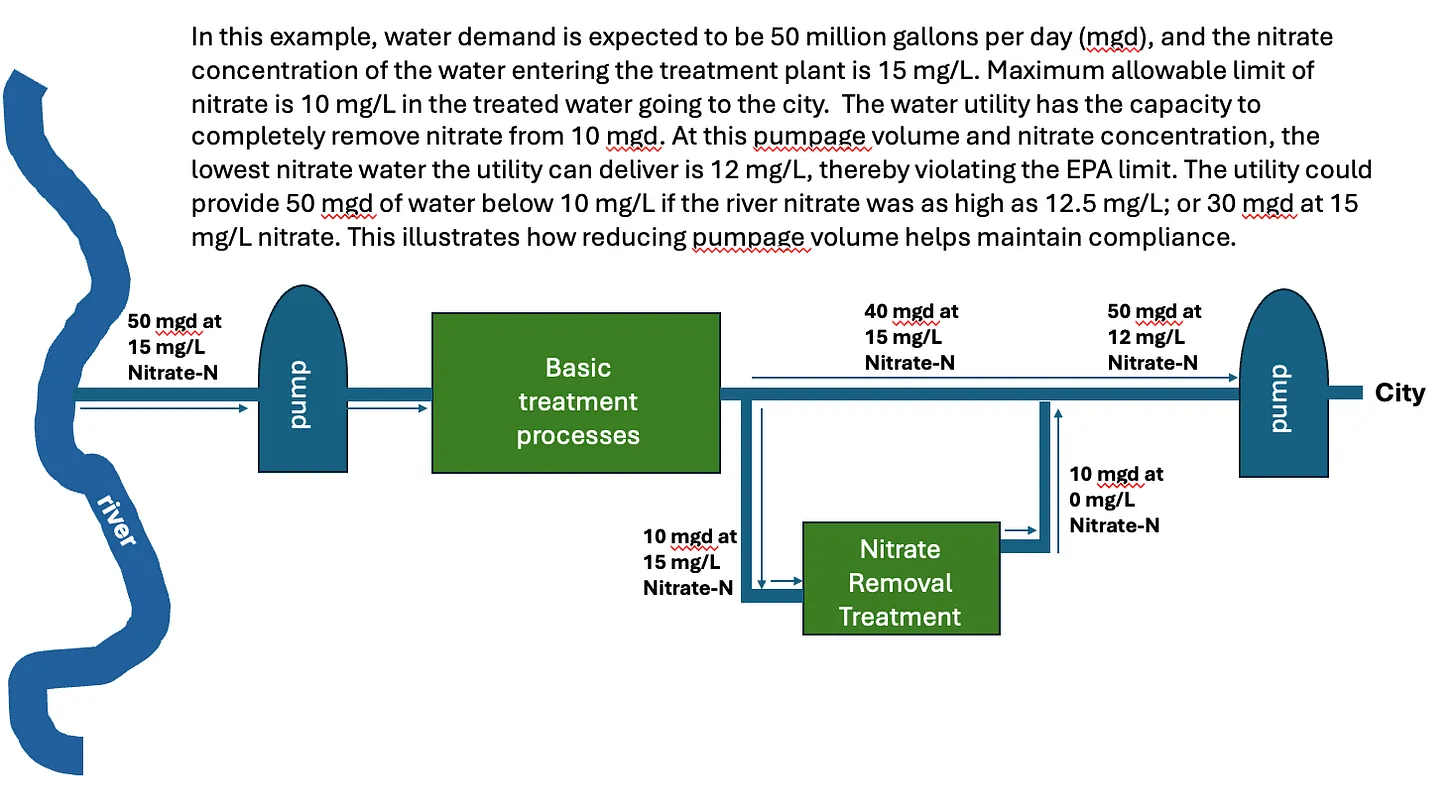
Last week the newly organized Central Iowa Water Works (which includes Des Moines Water Works) asked residents to voluntarily restrict their lawn watering 25%. This request was not because of low flows in the region’s two water supply rivers (Raccoon and Des Moines), but because the main Fleur Drive treatment plant lacks the capacity to remove enough nitrate when high concentrations coincide with high water demand. The diagram below illustrates this concept.
When you live in a neighborhood of $750,000 houses in Ankeny or Waukee, a brown lawn disgracing a street of green is something that goes over about as well with your neighbors as a rusty 1985 Winnebago parked in your driveway. And, you probably ask yourself, why the hell pay for installation and maintenance of an expensive sprinkler system if you’re not going to use it. You’ve had a month of lush, green grass that you wish would last to Labor Day and beyond. But spotty rain and summer’s first heat threatens to burn up the sod laid upon hardpan clay because your homebuilder scraped off the topsoil and sold it so he could spend January golfing in Palm Springs.
Call it the heartache of suburbsoriasis.
Also part of the equation is that many public water utilities need revenue from lawn irrigation. In a city without a lot of large industrial water users, like Des Moines, for example, lawn watering helps pay for the critical infrastructure needed (like nitrate removal) to ensure a continuous supply of safe water to the community. It all just screams ‘America’, doesn’t it? The customer wants more water for gratuitous uses, the utility needs more money for water treatment, but the pollution requiring extra treatment gets in the way of gratuitous water use.
So I guess the message in Central Iowa is, please irrigate a little bit less because we can’t deal with the pollution. We all want green grass. Until we don’t, that is.
I took a look at nitrate levels in Iowa streams over the last month because, well, habit dies hard I guess. While not in record territory, nitrate levels have been righteous indeed as Iowa Agriculture continues to casually send their raw materials down to the Gulf of Mexico like a University of Iowa frat boy dumps out halfa can of Busch Light that got warm while he tried to make time with Harold’s granddaughter from Crawfordsville.
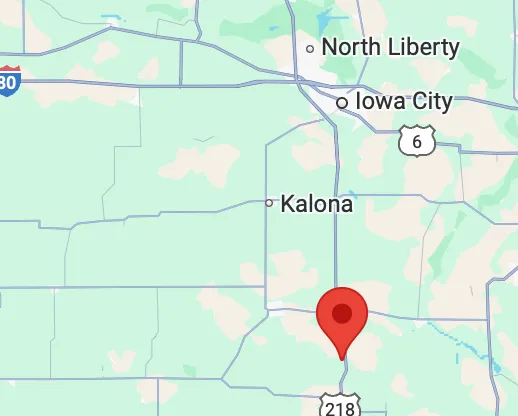
Here are some stream nitrate data for selected watersheds from May 1 until June 2. Nitrate concentration data were obtained from USGS and UI-IIHR. Nitrate loads were calculated using USGS discharge data. Yield (loss per crop acre) was calculated using Iowa DNR land cover database.
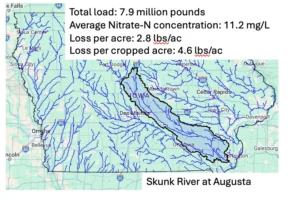
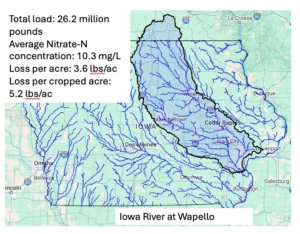
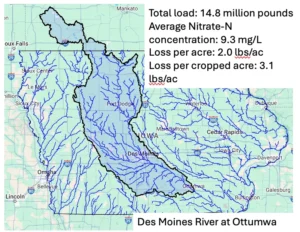
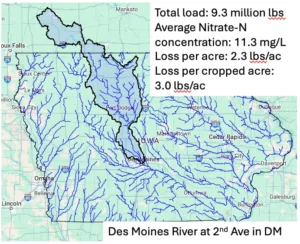
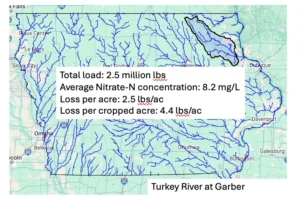
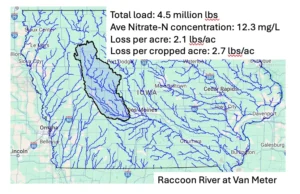
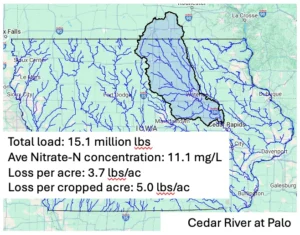
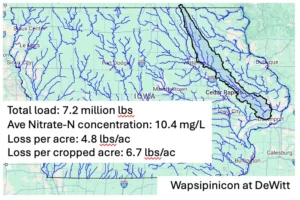
Iowa’s three major municipal water supply rivers, the Raccoon, Des Moines and Cedar, were above the drinking water limit a combined 77 out of 99 days for the period examined here (May 1-June 2) and had an overall average nitrate-N concentration of 11.6 mg/L. In one of its most politically brazen moves ever, Iowa DNR decided these rivers were no longer polluted for nitrate and tried to designate them as such. EPA intervened. More on why I think DNR did this will be coming in a future post.
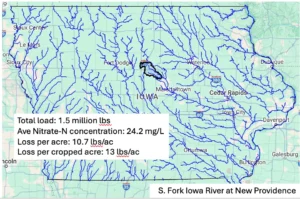
One more watershed: South Fork of the Iowa River at New Providence. Receiving water from mainly Hamilton and Hardin Counties, South Fork was ‘voluntary conservation’ before voluntary conservation was cool. The South Fork Watershed Alliance was formed in 1999. Since then public dollars spent on that watershed have helped support a virtual army of university, government, and NGO scientists and conservationists and produced about 274 citable publications on Google Scholar, and I’m an author on a couple of them.
The lowest nitrate concentration measured on that stream over the past 35 days was 17.1 mg/L; it dipped below 20 on only two days and exceeded 30 on two days. That site requires a specially modified nitrate sensor adapted to measure extremely high concentrations. The watershed lost a headslapping 13 lbs of nitrate-N per cropped acre during that time. Here lies an example of all that is perverse about Iowa’s water quality improvement efforts. Hamilton and and Hardin counties are home to 1.5 million hogs, more than 3 times the density of the rest of the state, and Hamilton County has long been a center of Iowa’s egg production. The idea that good or even adequate water quality can be achieved with this level of livestock production is foolhardy and has resulted in the waste of perhaps millions of public dollars to pay for research and Back 40 Brand Band Aids that fantasists think will change the polluting paradigm.
Iowa’s approach to this problem has been great for people like me—job, publications, and the opportunity to study nature’s systems. It’s also been great for farmers and agribusiness because they haven’t gotten pinched, and have been allowed to merrily go on with their polluting ways, this going back to 1992 when Des Moines installed nitrate removal treatment.
But it’s been terrible for the larger body of Iowa citizens. Try to find a bigger failure of Iowa government to address a problem that effects every single citizen. I don’t know of one.
No reasonable person can look at a place like South Fork and think we can solve this problem within the backdrop of the existing production paradigm. It’s lunacy. People in Ag and the universities and government know this. They know it. So at this point I see this nitrate pollution as flexing—flexing on the part of establishment agriculture. The pollution, and the deliberate failure to address it, are statements of power. In effect they’re telling us, we’re so big and so powerful that we can pollute the very water you drink, and you can’t do a damn thing about it. So remember that, chumps.
Photo by Rémi Müller