
I’m sure many of you share the feelings I have about the current state of affairs in our country. Beyond the events themselves, more despairing is the fact that an approximate majority of our fellow citizens are happy with them. This is very difficult to reconcile with what I learned were the foundational principles of America.
Retribution for expression of speech that the ruling establishment finds uncomfortable is now so common that writing a piece of this sort requires no citable examples. It’s part and parcel to life in this country now. A leftward swinging pendulum that dropped the lid of political correctness atop a pot of resentment, racism and bigotry has now swung so far back to the right that people fear for their jobs and maybe their lives for simply expressing empirical truths. The death of empiricism ultimately will mean the death of free and civil society. Scientists should know this better than anybody.
This is a topic that I think I know something about. When I was writing my university blog, I noticed that publicly accessible blogs produced at Iowa State were covering many of the same topics I was from my desk at the University of Iowa. There was nothing wrong with these other pieces, but they were written in a matter-of-fact style typical of academia. Anyone doing what I did, i.e. studying the dynamics of agriculture and environment, could see that this approach failed to educate the public in a meaningful way. I tried something different, and of course this was met with some anger from the ag establishment and some in the legislature.
I have it on good authority that one particular member of the legislature said at one of my speaking events about two years before my retirement that he was “going to get me”. I saw him then as I do now—a buffoon and an insecure bully. But that very day I saw people in the environmental community try to cozy up to the guy, and I’ve seen it happen since, I suppose because they fear him, but I don’t know. What’s written in this paragraph affects my approach to things still.
The buffoons mostly control the levers now, but can we steer the ship back to Port Sanity by refusing to relinquish our grip on the lever labeled ‘Empiricism’? I hope so.
Surely many of you seek refuge from the news in the outdoors, nature and the laws of the universe. It seems the bullies would like to deprive us of even that, if they can pull it off. Even if they do, physics, chemistry and biology are what they are, and always will be, no matter how hard the buffoons try to deny it. Always will truth exist to be found there.
One of my heroes is John McPhee. He’s written 32 books since 1965 on topics as wide ranging as a biography of Bill Bradley to dense geological narratives of North America and Iceland. He is considered a pioneer of creative non-fiction.
His third published book (1968) was Oranges. If by now you’re following my thought process here, you’re recognizing that I figure if McPhee can write an entire book with the one word title “Oranges”, I can write an essay titled “Peaches.” Here goes.
Regular readers know my orchard is now five years old (2021). Two of my original trees (there have been additions and replacements of dead trees since) were Contender variety peach trees. I chose this variety because it’s cold hardy to USDA Hardiness Zone 4 (average annual minimum temperature of -30F) and at least part of the Driftless Area where my orchard is located creeped in and out of Zone 4. USDA revised the hardiness zone map in 2023 and now I’m pretty solidly in Zone 5. I’ve since planted three more peach trees, two of which have died and one which has not bore fruit yet.
Those two original 2021 trees produced a handful of peaches in 2023 and then 125 last year, which I was ecstatic about especially because the peaches were extremely delicious. I carefully pruned the trees last winter after watching several how-to You Tube videos and expected a similar crop in 2025.
The trees bloomed nicely this past spring, but peach flowers are small and I gave no mind to how many peaches I might get based on blooms. Jack Frost stayed to the north during the month of May, leaving the blooms unscathed.
Long about July 1, I started noticing what looked like A LOT of small green peaches and by July 15th they were large enough that I could make some eyeball estimates—I guessed 400. B came down and looked and she guessed 1000, but I thought she was being hyperbolic.
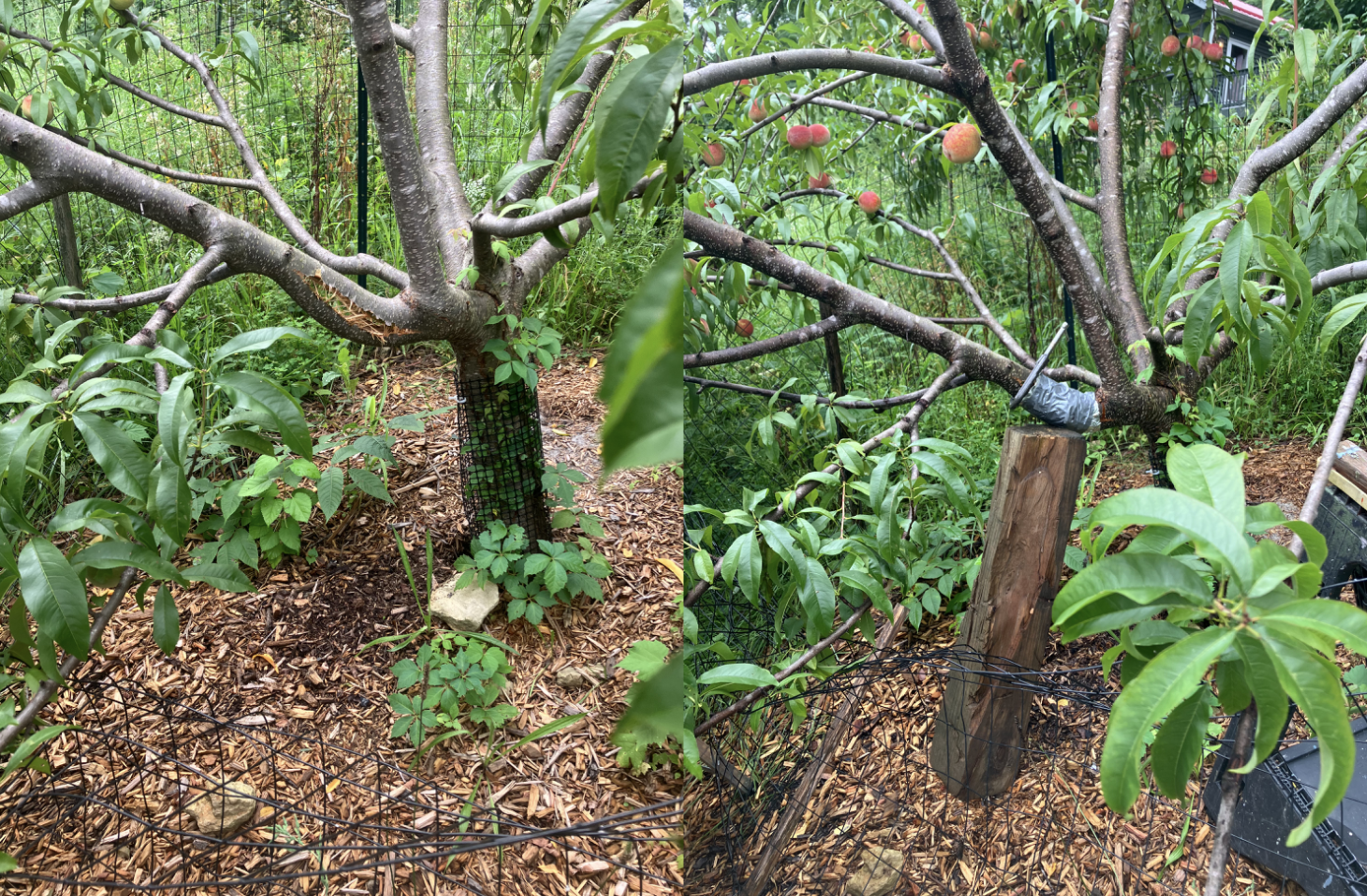
By the end of July, I started to think 1000 might be close. August 7th saw a few starting to ripen and then I heard a crack from my bed after a brief pre-dawn rain shower. One branch with at least 100 unripe peaches had split. I don’t know if the branch broke because of the water weight lying upon the leaves or the peaches gaining weight. I jury-rigged a patch and prop for that branch to try to save it.
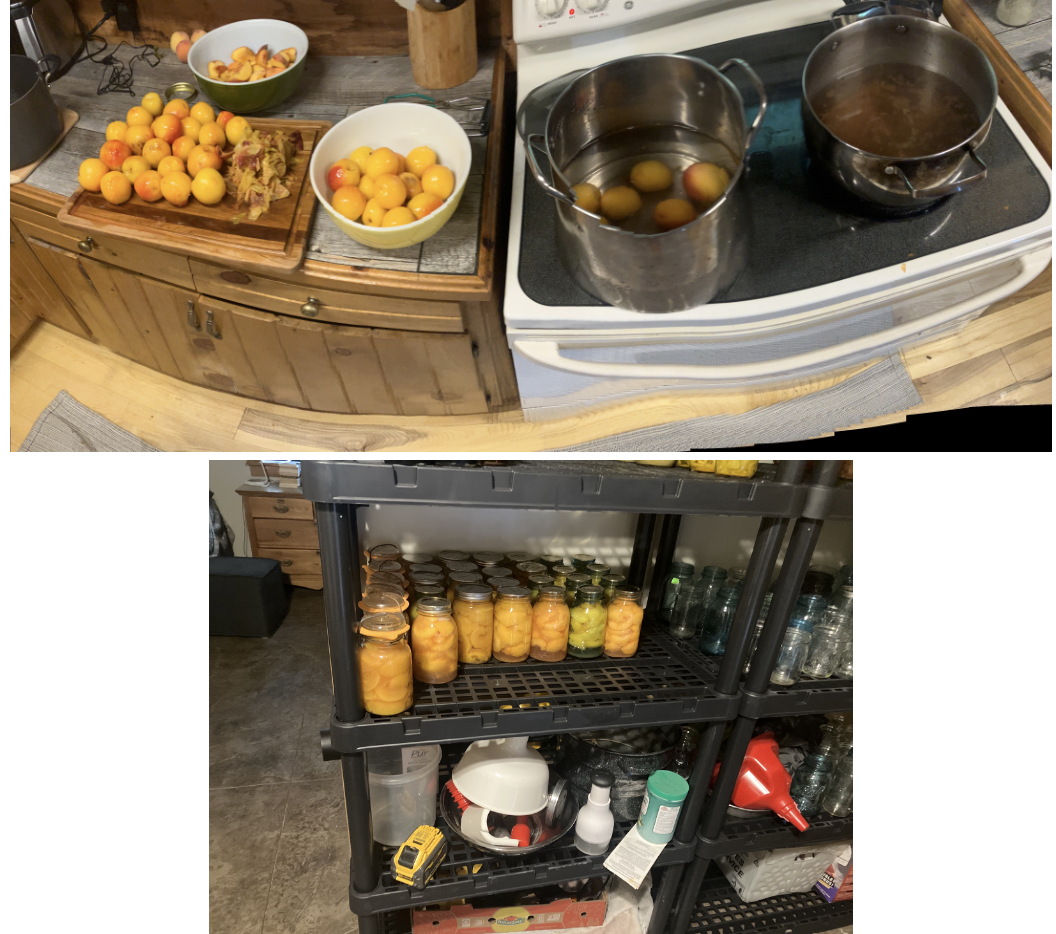
I was determined to record the number of peaches picked and their individual weights. As they ripened, I picked about 75 every morning for several days, weighed them individually on a kitchen scale and then recorded their weights in an old lab notebook. Early on I did not pick unripe fruit. This went on until Saturday, August 16th, when things got out of hand. Another shower cracked another branch and the fruit started to ripen en masse. Birds paid me no mind as picked peaches almost right out of their beaks. For the sake of time, I had to abandon my data collection idea. By the end of the day on the 17th, I had picked about 800 and about 3/4 of these were just from one of the trees where ripening was proceeding more rapidly. That entire week of August 10th I was canning and freezing peaches.
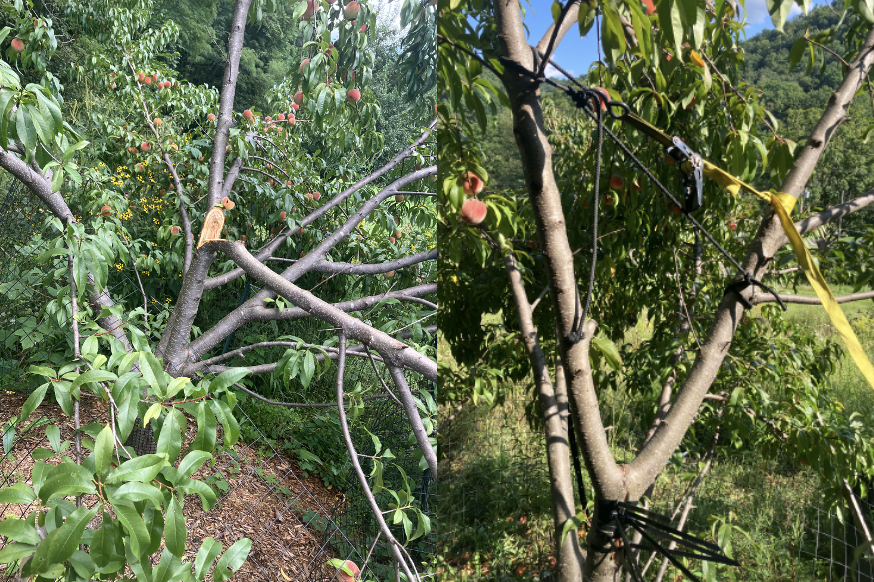
I went back to Iowa City on the 17th, had a peach daiquiri party the night of 18th, and returned to the cabin and orchard on the 19th to begin Peachalooza Part II. I froze and canned and canned and froze and carted little flats of peaches around town to people I know. By the 24th, 90% of the fruit was off one tree and about 50% off the other. I waved the white flag on the 31st and decided that was it. The peach grease and slime coating the sloping ground around the trees made further picking treacherous and I had no energy to sort through fallen peaches looking for the 10% that weren’t bruised or pecked by birds. My best guess is that 1500 peaches made it into stomachs, canning jars and freezers and 500 were ruined by birds or eaten off the ground by critters.
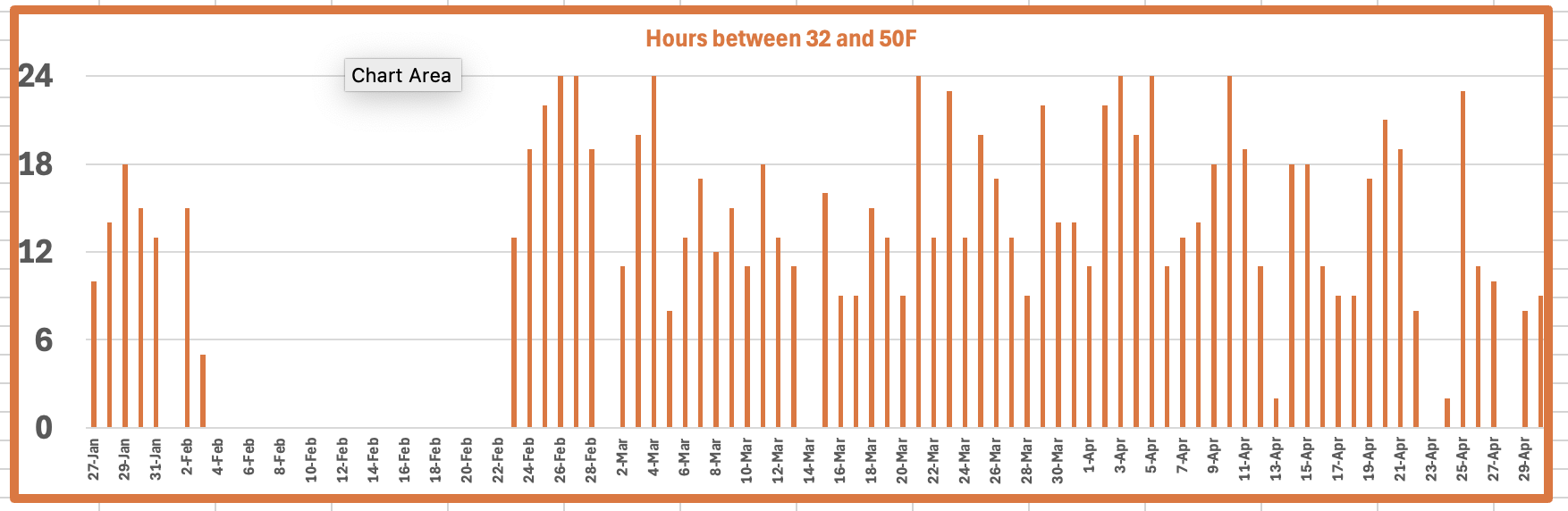
I began to wonder if the magnitude of this crop was a freakish occurrence. One of my neighbors told me his brother-in-law in La Crosse had a peach tree and he stopped picking at 1000 peaches. A few internet searches told me that peaches need a ‘chilling’, i.e. a period of time when the air temperature is within a certain window. For my variety, Contender, the optimal chilling period is 1000 to 1050 hours between 32 and 50F. This is when the magical chemistry happens in a peach tree that determines how many blooms the tree will produce. Some or all of those blooms can be nipped by frost and killed completely by a hard freeze, which is the main obstacle to growing peaches in the Upper Midwest, versus Georgia, Missouri and Colorado.
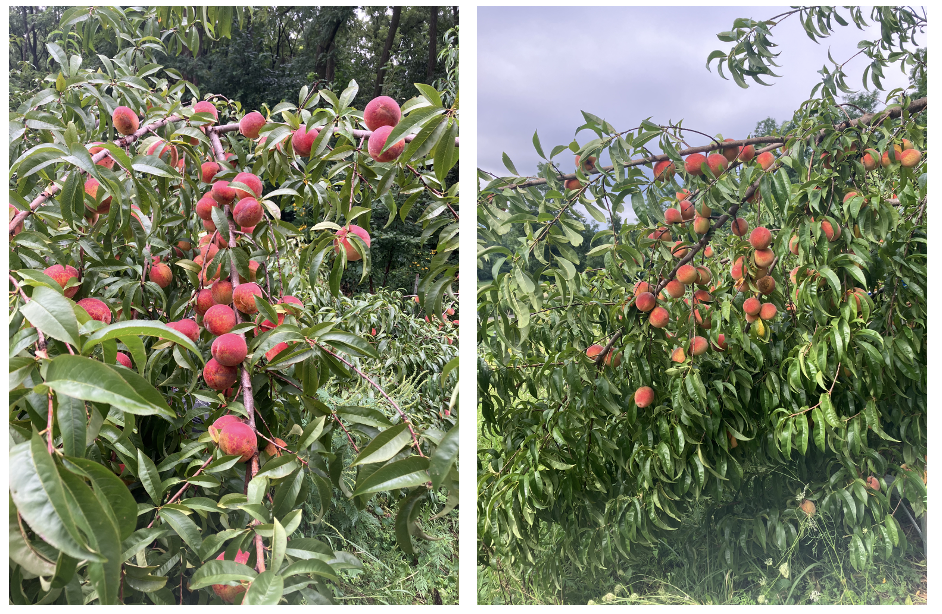
I thus began a search for hourly temperature data for my area, and finding none, turned to my atmospheric chemist daughter for help. She steered me to the MesoWest website run by the University of Utah, where I was able to find what I needed. It turns out my peaches did indeed have a Big Chill(ing). From January 16th to April 30th, about the time the blooms emerged, my peach trees had 1043 hours in the 32-50 degree sweet spot. The last frost was April 11, long before the first blooms emerged, and so none were nipped by J.F. A big crop was baked in early like my peaches in a cobbler.
I’ll finish here with a couple garden observations/experiences that may interest some. I plant about half of my garden to garlic in the fall. This is harvested around July 15 and the past two years I have planted cucumbers and turnips to that space in a successional planting—the cucumbers immediately and turnips the last week of July. I love turnips for winter soup making and like pickling cucumbers. I have not had the best of luck with either planting them earlier in the season.
The turnips are just fabulously good. The greens are soft and smooth and velvety and B says the roots look like they will jump out of the ground and walk into the cabin on their own. They’re snow white, unblemished, and free of worms. I’m also now picking an enormous cucumber crop, which poses a problem since I unexpectedly used almost all my canning jars for peaches.