
But there’s hope—it doesn’t have to be that way
I’ve been looking at nitrate and weather data for the Iowa River at its outlet at Wapello, Iowa. This is Iowa’s 2nd largest interior river basin and is drained by two major rivers, the Cedar and the Iowa. The Cedar is actually the bigger river at the confluence but that last section of combined flow retains the name of the smaller branch.
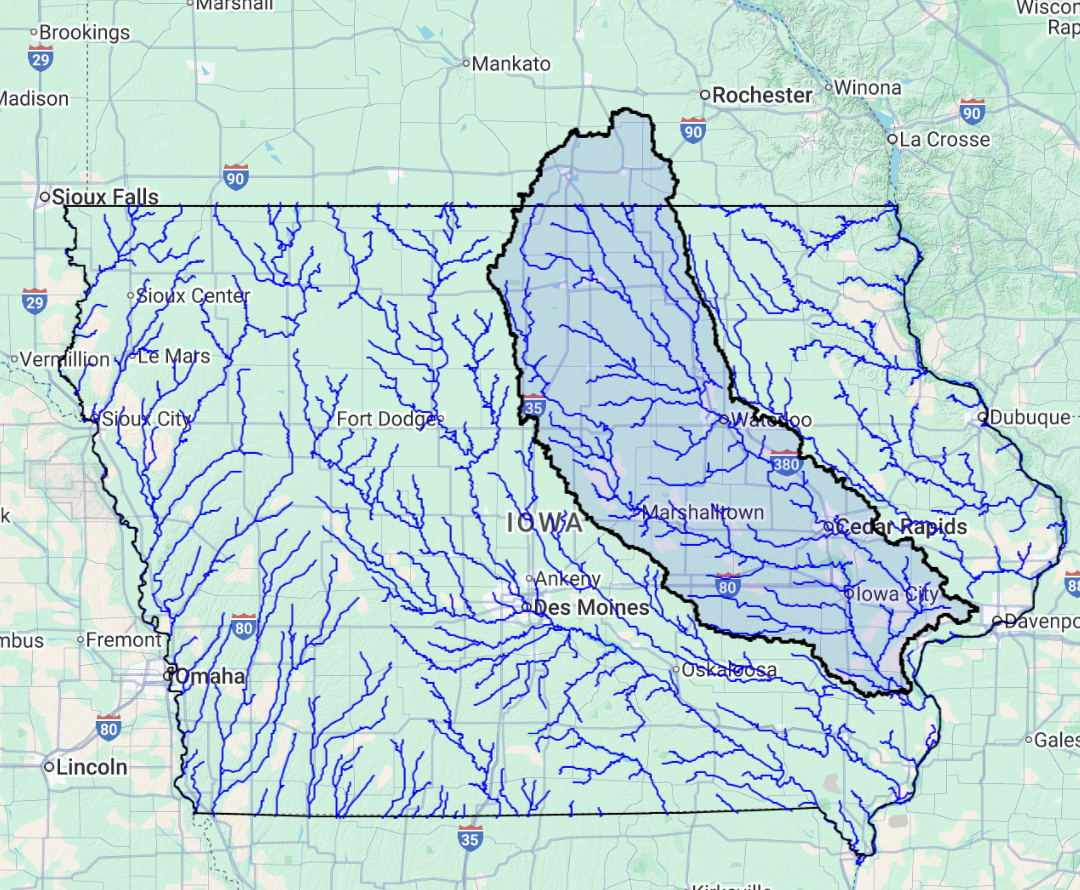
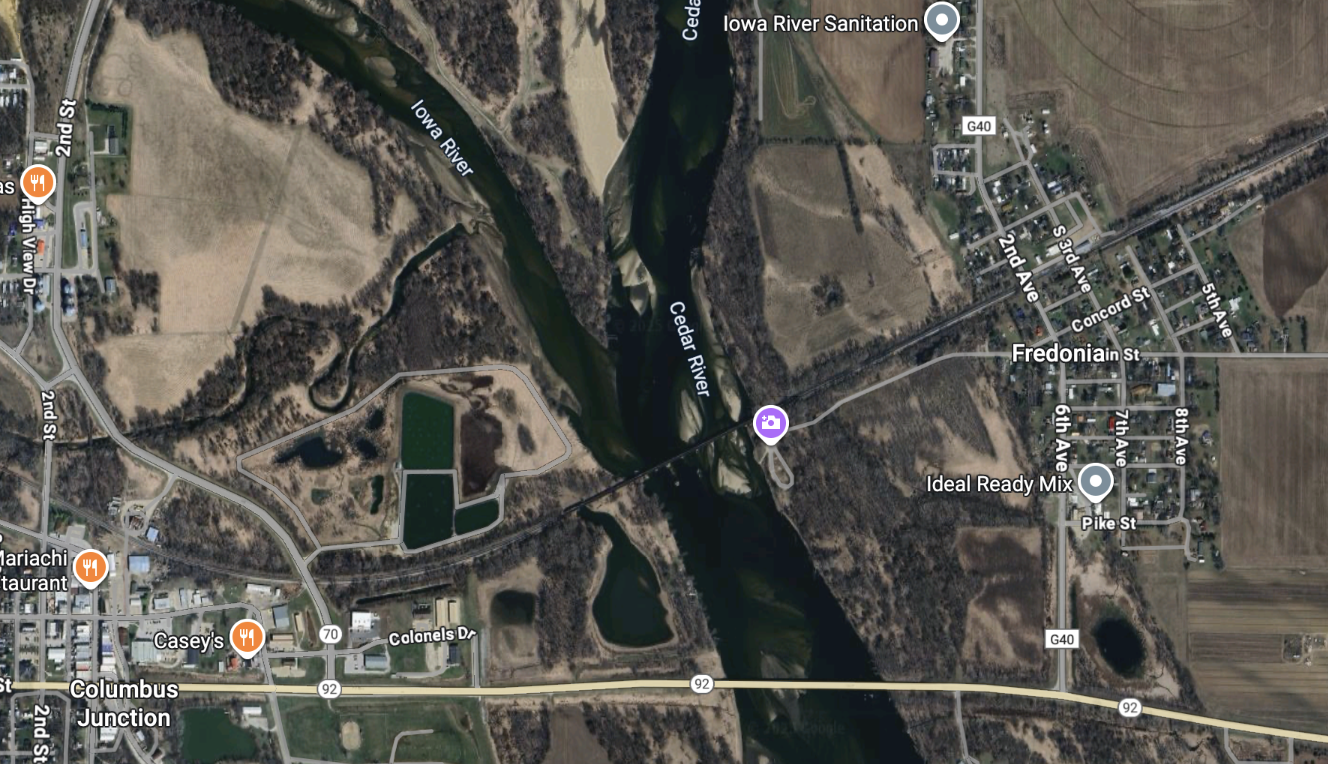
First, some notes on the data. The nitrate data are from the USGS sensor at Wapello and the Iowa DNR ambient monitoring station. I also used river discharge data from the USGS station. The precipitation data are from the Iowa Environmental Mesonet at Iowa State. Yearly data is shown as water years (Oct 1-Sep 30). Thus the 2025 water year ran from 10/1/24 to 9/30/25. The period examined is 2018-2025 for the simple reason that I had data for this site conveniently aggregated on my computer from my past work managing the Iowa Water Quality Information System sensor network. The intention here is not to illustrate or comment on any long-term trends.
The graph below shows annual nitrate loading data for the site (Iowa River at Wapello). Load is the mass of a pollutant transported by a river over a defined time period. It is the product of the concentration (i.e. ppm or mg/L) multiplied by water discharge (flow).
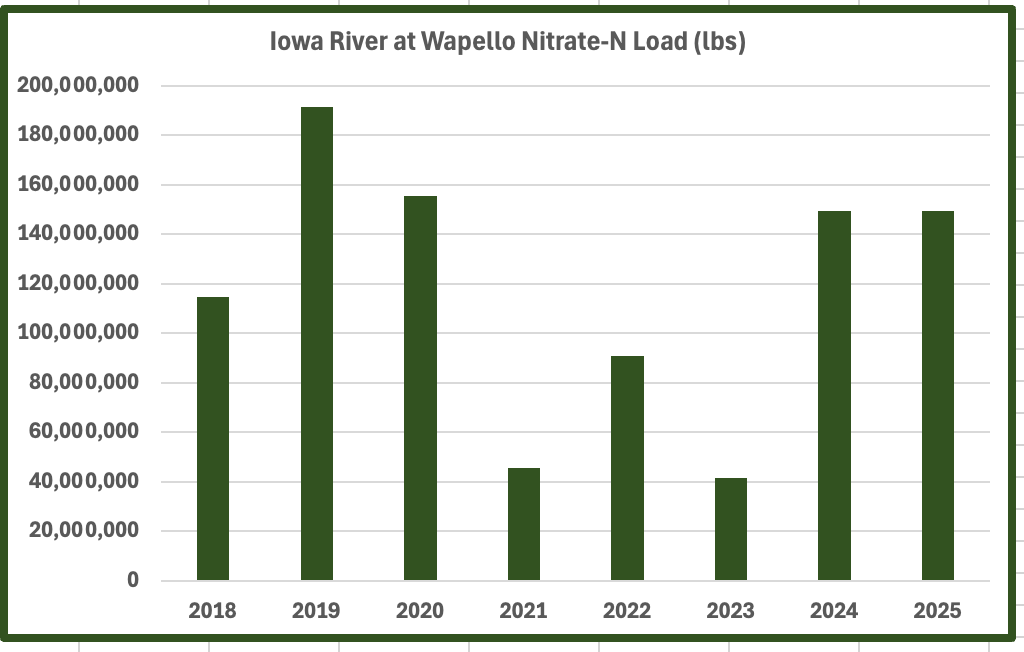
The average load (amount of nitrate-N transported by the river) for the past eight years was 118 million pounds, which is enough nitrogen to fertilize 800,000 acres of corn. That’s an area of land 35 miles x 35 miles. The amount of nitrogen leaving the watershed is enough to fertilize 28% of the corn acres *in* the watershed. So agriculture is wasting almost 30% of their product in this basin.
Nitrogen loading this past year was amazingly similar to 2024—the two years differed by less than 1%. They were so nearly identical that I had to go back and double check the data for peace of mind.
Note that the range of values over the eight years is quite large; they vary over a factor of 4.6. In other words, the largest loading year is 4.6 times as large as the smallest loading year.
The common message delivered by the agricultural and political establishment is that these high nitrate years (like 2025) are driven by weather. So let’s look at that.
Iowa has nine climate zones and this large basin receives water from five of them: North Central, Northeast, Central, East Central, and Southeast. I averaged rainfall from all of them to create this graph:
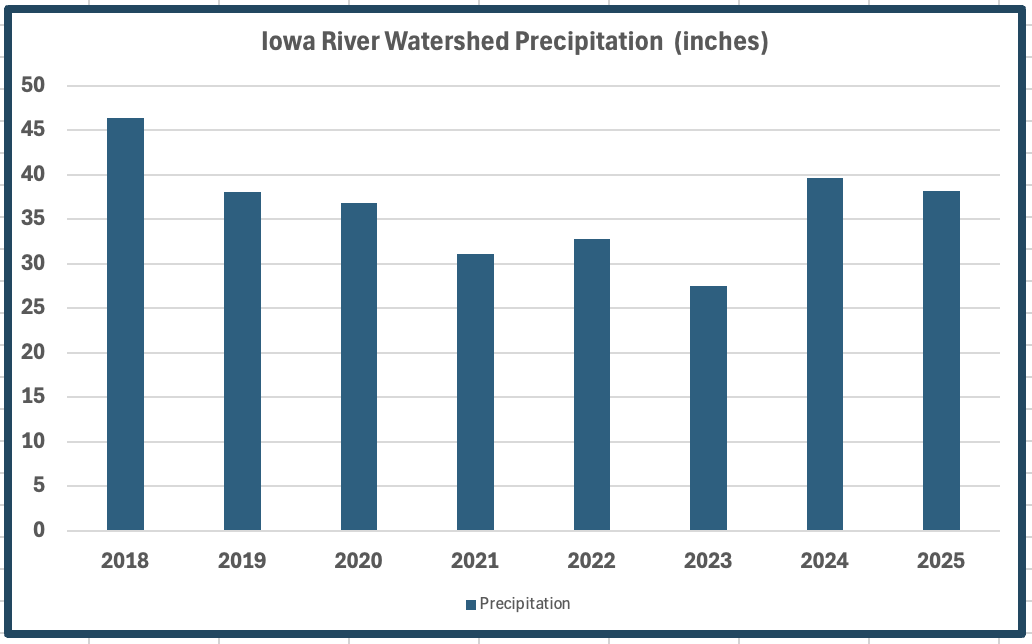
A general rule of thumb for the eastern half of Iowa is annual precipitation below 30”is dry and above 40” is wet. We can see there were two such years—2018 (wet) and 2023 (dry). But note that the range of values here is much smaller than for N loading, with values varying only be a factor of 1.7. Remember that number for the N loading was 4.6.
Now let’s look at corn yields for the five climate zones draining to the watershed (2025 not available yet).
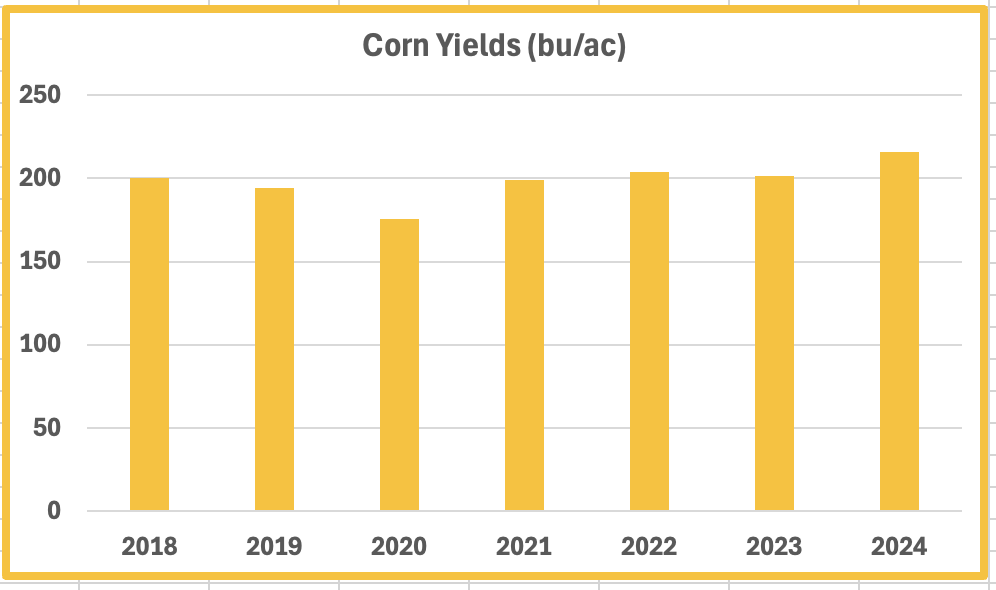
The range of values for corn yields varies only by a factor of 1.2. The best year is only 1.2 times better than the worst year. So nitrogen loss, 4.6; precipitation 1.7; corn yields 1.2. This tells us a couple of important things.
Firstly, the system is designed for crop yield and not for environmental resilience. Crop yields are dependable, regardless of rainfall; N loss is not dependable or even really that predictable. Very modest variations in rainfall cause N loads to wildly expand and contract.
Secondly, this tells us that one way the industry achieves dependable crop yields is by over-applying nitrogen. That way in wet years, they won’t lose too much such that the corn is nitrogen deprived. In dry years, that over application is banked in the soil matter (in a process called immobilization) and water table aquifers and then is unleashed to the stream network when precipitation returns to normal or wet. This is one of the origins of “it comes from the soil” that Iowa State faculty use to mislead the public while providing cover for the industry. This borders on the sinister for a public institution, in my view.
A person might make the argument that if the goal is to get about 200 bushels of corn per acre, year after year, with almost no variation, then they’re not over applying, they’re applying exactly the right amount. Politicians are fond of buying into this line of thinking; Governor Kim Reynolds did exactly that this past summer: “There is a cost to those inputs, and so farmers are not being extravagant. They’re not overusing. They’re putting on the least amount that they can to be able to grow the crops and get the bushels that they’re aiming for.”
And herein lies the problem: farmers have been conditioned by the industry and their lackeys in the universities to focus on yield and not return. Practical Farmers of Iowa recently conducted a ‘reduced N rate study’ and found 86% of the studied farms increased revenue by reducing nitrogen fertilizer application rates.
So why doesn’t the larger body of farmers embrace the reduced application rate strategy? The conventional wisdom is because they’re willing to trade increases in long-term income for less year-to-year variability. And surprise, surprise, users of commodity grains like predictability too. You and your water are the collateral damage.
Don’t think for a second that what I’ve just written provides any new discoveries or insights that will transform the system. It may or may not surprise, I don’t know,. that inside ‘the circle’ (industry and academia), people have known this stuff FOR DECADES.
About 15 years ago or so, there was some anxiety that the federal government might want to regulate the Mississippi Basin for nutrient (nitrogen and phosphorus) pollution. This would’ve been in alignment with the federal government’s approach to such pollution in the Chesapeake Bay. This is the nightmare scenario for a fertilizer industry that wants to sell as much as they can sell to compliant farmers. Then in 2011, Nancy Stoner, then an acting assistant administrator at EPA, issued the now-famous ‘Stoner Memo’ which gave states license to create voluntary nutrient pollution plans. There was a fair amount of head tilting regarding why EPA chose to do this, and I have some thoughts on that, but I don’t want to get sued so I’ll keep them to myself.
Iowa was first to exploit EPA’s permission slip, with the ag industry, Iowa Department of Agriculture and Land Stewardship, Iowa DNR, and Iowa State University working to create the Iowa Nutrient Reduction Strategy, which was released in 2013. This outlined a list of ‘approved’ practices that farmers could (voluntarily) use to reduce nitrogen and phosphorus loss from their fields and plotted a prescriptive nutrient reduction roadmap for municipal and industrial discharges so we could tackle their tiny contribution to Iowa nutrient pollution. The stated goal of the strategy was aligned with that of the Gulf of Mexico Hypoxia Task Force, which was a 45% reduction in nitrogen and phosphorus loading to the Gulf to reduce the size of its dead zone to pre-1981 levels. There is no timeline for Iowa’s objectives, there are no consequences if it isn’t met, and farmers suffer no ill consequences if they refuse to adopt approved practices.
There was and is nothing in Iowa’s strategy about addressing Iowa’s municipal drinking water or the cauldron of pollution that is now characteristic of almost all our lakes, so it’s interesting that politicians trot out the nutrient strategy as a prop when these issues crop up. About a million Iowans drink water containing nitrate at levels associated with increased cancer risk.
Some (many?) have been trying to get farmers to see the light on nitrogen rates (amount applied to crops) for at least 40 years, and really nothing much has changed in that regard. So many farmers tenaciously resist reducing rates that advocacy groups soften the message to ‘4Rs’: Right Source (kind), Right Time, Right Place, and Right Rate. This is what industry apologists call ‘directionally correct’; ‘grossly insufficient’, in the words of one my colleagues, is a better characterization. Using language most are accustomed to, yeah, it makes sense, but it’s got a snowball’s chance in hell to improve things. After 20 years of this, the worst nitrogen practice with the worst loss, fall application of anhydrous ammonia, is on the rise in Iowa.
In an expert report to the Minnesota Center for Environmental Advocacy, respected researcher Gyles Randall (retired, University of MN) said that: “Shifting a small portion of Minnesota’s corn acres to other non-N demanding crops, such as alfalfa into crop rotations or establishing perennials on marginal land areas would likely reduce nitrate losses more than simply implementing Nitrogen BMPs (Best Management Practices) for the current corn and soybean dominated landscape.” Huh. So growing less corn and soybean would help? Whooda thunk it.
And nitrogen (nitrate) is only one of many ag pollutants we could talk about in this context.
Do we want better water in Iowa? Some clearly do, but collectively, who knows. My observation is that the jury is out on that. The overwhelming majority of our politicians in both parties seem ambivalent about it. And history shows we are not inclined to hold our elected leaders accountable on the issue.
I will debate any and all comers on this point: agriculture as it is currently configured in Iowa (corn/soybean/CAFO) degrades the quality of life for almost all of us that live here, as well as that of other species that are native to our state. Agriculture degrades the livability of Iowa. There just cannot be any doubt anymore. Our children and grandchildren see this with more clarity than older generations and many are choosing to leave—for good. My three children are long gone. The tragedy is that it doesn’t have to be this way. With not a huge amount of effort, Iowa could remain a working landscape while also fostering the well being of people and native plants and animals. Greed and cowardly leaders stand in the way.
The polluted state of our water—streams, lakes and aquifers, is but a symptom of the greed and perfidy that keeps the quality of our lives in this degraded condition.
We don’t have to tolerate this pollution.