
….of bullshit
The We All Want Clean Water crowd has returned from hiding to bestow a mountain of misinformation and stupidity upon the good sense of Iowans. Apparently they think time enough has passed since Central Iowa Water Works forced customers to involuntarily restrict water use because of high nitrate levels. The worst of these by a mile was governor Kim Reynolds, who in a 13-minute interview with KCCI TV (Des Moines) unloaded so much horseshit that I half expected Amish farmers to storm the studio afterwards to lay claim to it. So much misinformation passed the governor’s lips I hardly know where to start, but let’s begin with the claim that “There is a cost to those inputs, and so farmers are not being extravagant. They’re not overusing. They’re putting on the least amount that they can to be able to grow the crops and get the bushels that they’re aiming for, but they’re also doing it in a responsible manner.”
Hmm, what does the state’s own data say about this?
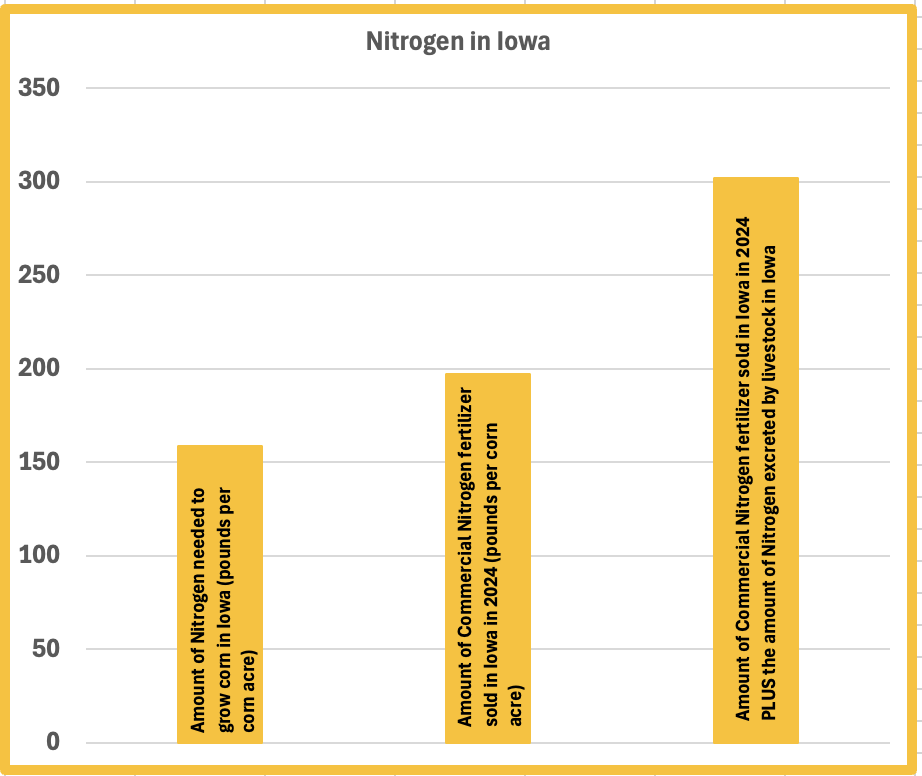
Fertilizer distribution reports are available from Iowa Department of Agriculture and Land Stewardship (IDALS) and for the most recent crop year available (2024), 2.54 billion pounds of synthetic (commercial fertilizer) nitrogen were distributed in Iowa. Iowa farmers planted 12.9 million acres of corn last year, and 2.54 billion divided 12.9 million equals 197 pounds per corn acre. This is the highest value for past 11 years of data available on the IDALS website and exceeds the second-highest value by 9 pounds.
That value, 197 pounds per acre, is MORE THAN ENOUGH to fertilize all the corn in Iowa. Using the ISU’s N Rate Calculator, the Maximum Return To Nitrogen (rate at which further application of N becomes unprofitable) is 145 pounds per acre (lbs/ac) for corn grown in rotation with soybeans (about 2/3 of Iowa’s crop acres) and 187 lbs/ac for corn grown continuously (about 1/3 of Iowa’s crop acres). Algebra pencils that out to an overall average of 159 pounds per corn acre, 38 pounds per acre less than what was sold. Thinks that sounds bad? Well, pucker up Buttercup because Iowa’s hogs, cattle, chickens and turkeys excrete about 1.35 billion more pounds of nitrogen every year, which amounts to 105 pounds more per corn acre.
In total, distributed commercial N plus N excreted by livestock amounts to 302 pounds per corn acre, 143 pounds per acre more than what farmers need to fertilizer properly. Someone is sure to complain but but but a lot of that livestock manure is temporarily unavailable to crops or it evaporates or one thing or another but the fact is, it doesn’t float off to the Milky Way, it ends up somewhere in the environment and that somewhere can be your streams and aquifers. The graph below is illustrative.
Reynolds also says well, “you know this is Iowa and we have dry, dry, dry and then deluge”, with the implication that this drives unusually high stream nitrate. Is that what happened?
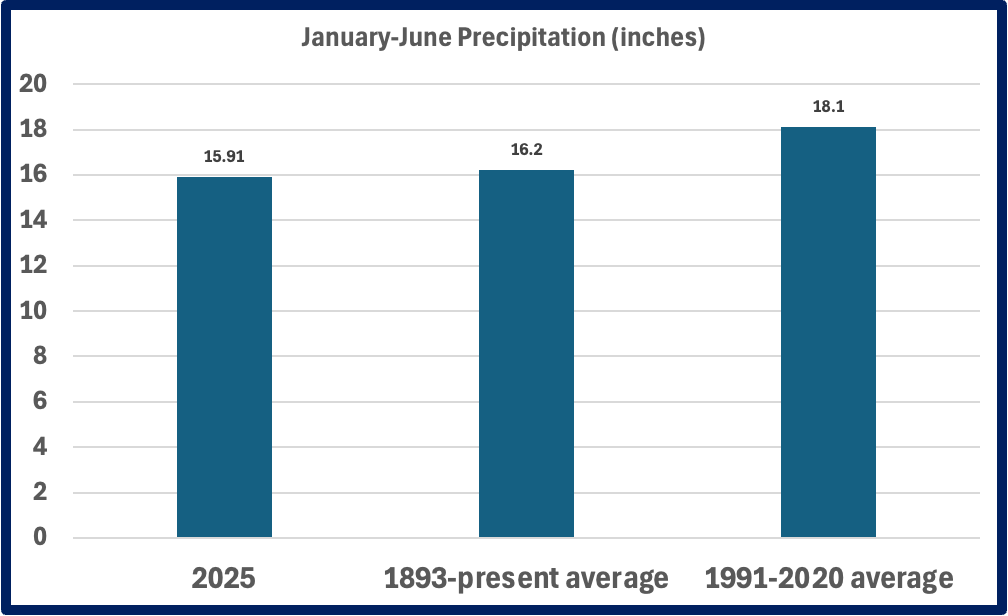
First, the supposed deluge part. Iowa’s precipitation over the past six months has been almost exactly normal compared to the long-term record (1893-present) and below average when compared to the 30-year climate normals (1991-2020).
What about the drought (dry dry dry as Kim says it)? I’ve heard the phrase ‘we’ve been in a ‘4-year drought’ tossed abought, so what abought that. Iowa has clearly been in a dry regime going back to the end of 2019, a year that ended with 43” of precipitation statewide. But last year (2024) was actually above normal precipitation statewide with 37.5” accumulated. I’ll (dry) humor the ag apologists anyway and look at the data more closely.
The 4-year period ending in 2024 (‘21-’24) saw a total of 124” of rain in Iowa. This would’ve been the 46th-driest such period in the historical record and something we would expect about 35% of the time. Almost 155” of rain was received in the 5-year period ending in 2024 (‘20-’24), the 39th driest such period in the record and something we could expect 29% of the time. Dry? Yes. Historic? No. If your farming system can’t endure a deviation from weather normals of this magnitude without leaving the surrounding environment awash in pollution, you don’t have a sustainable system. No way, no how. By that math, we can expect adequate water quality in only 30-40% of all years.
Was it dry enough to lower corn yields? Apparently not because the years 2021 through 2024 all had statewide average corn yields above 200 bu/ac (average since 2014—197 bu/ac). And this is where the ‘weather’ argument for the nitrate problem goes to die (or should). The ag apologists will straight-face tell you that N is banked in the soil in the dry years and loosed in the wet years (or deluge, as the guv says). If corn yields are still good in the dry years, for the love of all that is holy, why the f#&@! are farmers applying so much nitrogen that it’s getting ‘banked’ in the soil??!!!
As expected, Secretary of Agriculture Mike Naig has done his best to peg the bullshit meter to its maximum over the last week. In a LinkedIn post (not sure who the intended audience is for this but I suspect the legislature) Naig says that “Non-point source (i.e. agriculture) is one half of the equation.” This is interesting phraseology if we look at the actual river data over the past month.
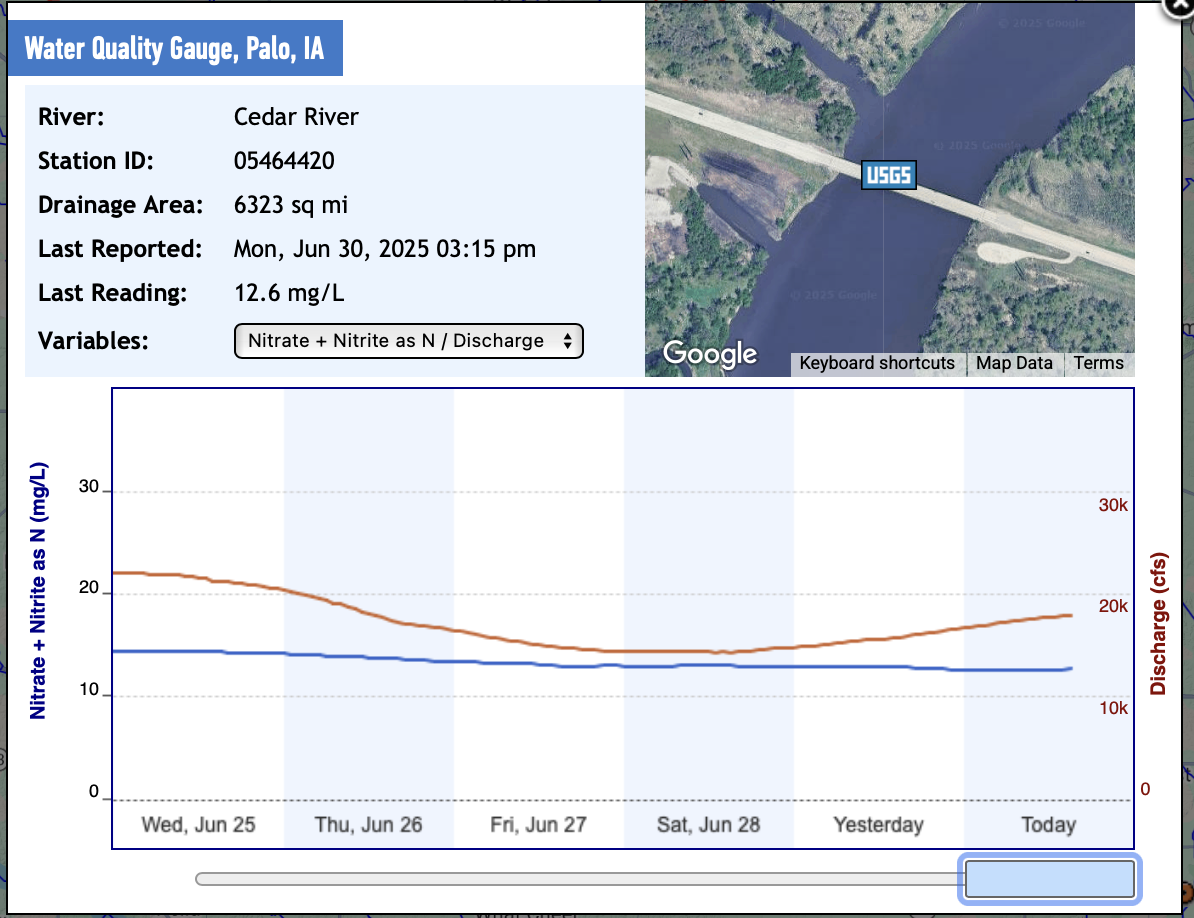
The graph above shows Cedar River discharge (flow) in brown and nitrate in blue. You can see that the nitrate concentration is unchanging around 12-13 mg/L while the flow changes quite substantially over the 6 days shown. That nitrate concentrations are disconnected from river flow is a strong indicator that almost all the nitrate in the Cedar River can be sourced back to agricultural drainage tile, used to lower the water table in cropped fields. This argues against the ‘deluge’ idea, which would produce a lot of low-nitrate surface runoff during rain events.
About 2 million miles of tile have been installed in Iowa, mostly north of I-80. The idea that 50%, or 20%, or even 5% of the nitrate in these streams right now is from cities, point sources, municipal wastewater treatment plants, lawns, golf courses, urban runoff, geese, raccoons and Uncle Frank from Farnhamville pissing off his deck after a couple of beers is complete bullshit. It may indeed be true that wastewater treatment plant discharge of nitrate in some rivers (Skunk, for ex.) at some times of the year (i.e. late summer) can be significant, but this nitrate event happening right now in Iowa rivers is all corn/soy/CAFO. They own it.
Naig also tells his LinkedIn followers that “Applying the right amount of nitrogen at the right time balances productivity and land stewardship.” How about that right time thing?
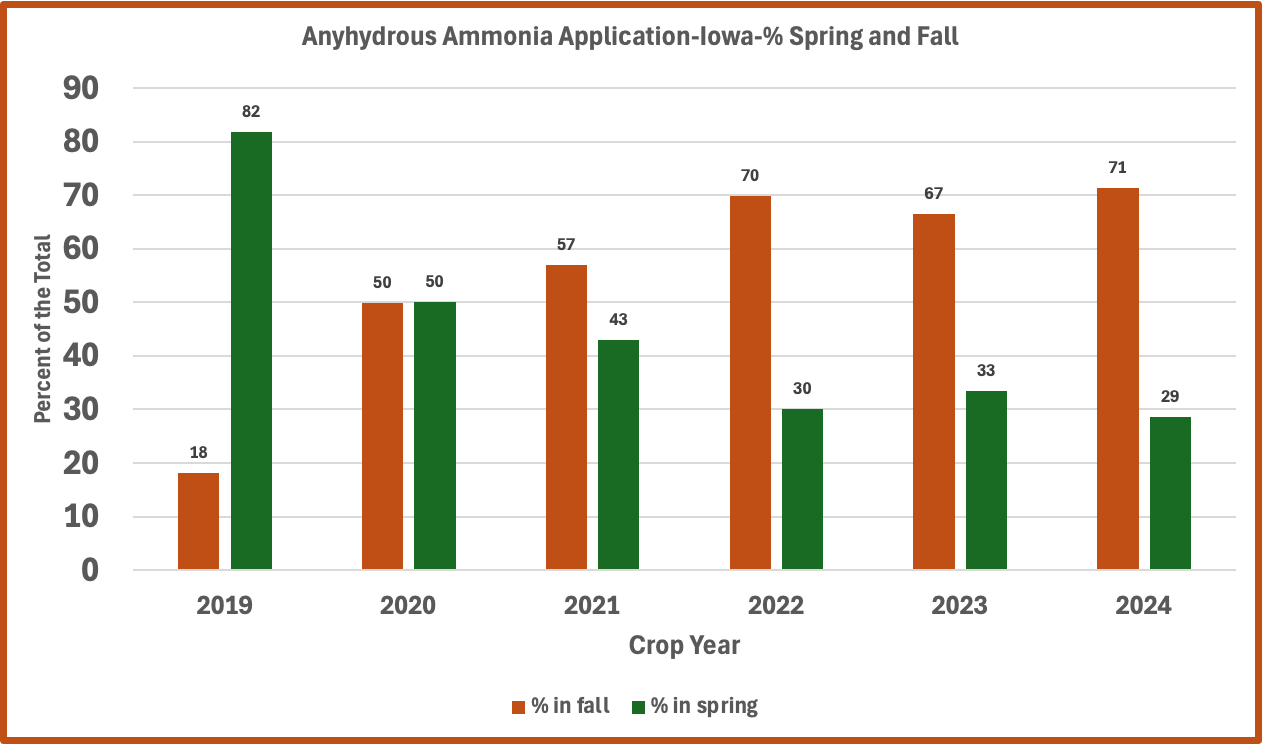
Iowa farmers apply anhydrous ammonia (nitrogen fertilizer) in both the fall and spring. Fall applied N has to sit there for seven months waiting for a crop that can use it. For that reason, farmers typically apply 10-20% more if they fall apply because they know they’re going to lose 10-20% more (and because retailers sell it for less in the fall). Guess what the trend is in Iowa (graph below) for anhydrous ammonia. Helpful hint for any democrat with a scintilla of courage running for office: propose taxing fall anhydrous ammonia. Or banning the practice completely.
Finally Naig tells the internet that we need to invest in water treatment infrastructure. Implicit in that statement is that water treatment plants in Des Moines, Iowa City, Cedar Rapids, Ottumwa, Manchester, Cedar Falls, Boone and other places that have had high levels of drinking water nitrate in the past potentially lack the capacity to cope with the pollution generated by the industry he represents. Thanks for the heads up, dude. Tell us something we don’t know.
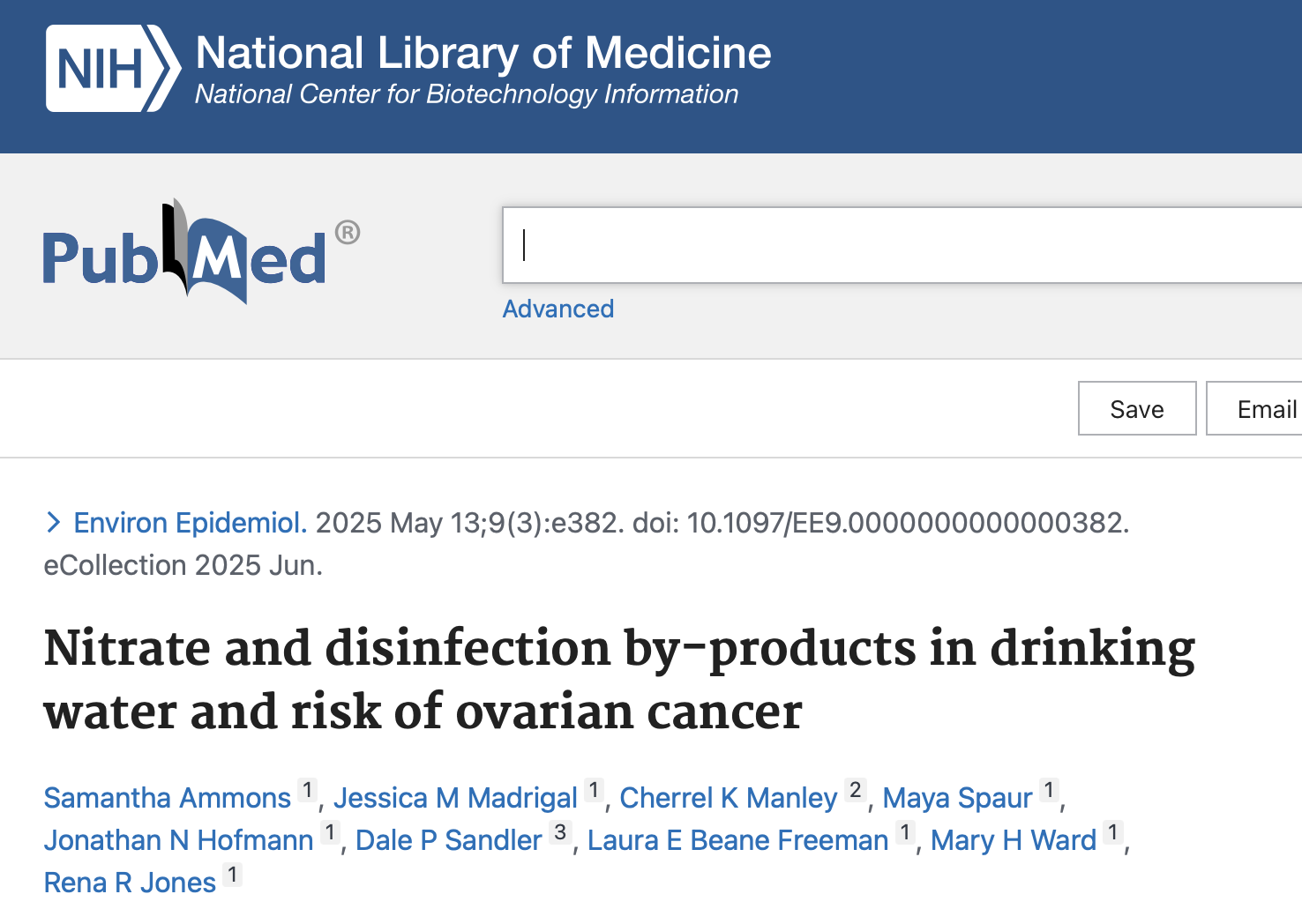
Nitrogen fertilizer applied to farm fields ends up as nitrate in your drinking water. Nitrate in drinking water at levels far below what people in the above mentioned cities are drinking is bad for you. Above 3 mg/L (ppm) presents risks, and if you live in Polk County or Dallas County, you may have consumed water above that level most days of your life. Once thought to be a threat only to newborns, the scholarly evidence for health risks in adults connected to drinking water nitrate has been piling up now for 25 years. Yet another paper published just last month shows increased cancer risk associated with drinking water nitrate, this for ovarian cancer. Other literature shows increased risk of birth defects and thyroid, colorectal, and bladder cancers.
Over the past 20 years I’ve been asked countless times if bottled water and/or home treatment devices are merited. I’ve almost always said ‘no’ or that it was a personal choice. Well, I’ve seen enough. My partner and I decided that the 8-9 mg/L nitrate regularly present this year in Iowa City tap water was enough to warrant action. At a cost of about $800, we had a reverse osmosis treatment unit installed for the ‘cold’ on the kitchen tap.
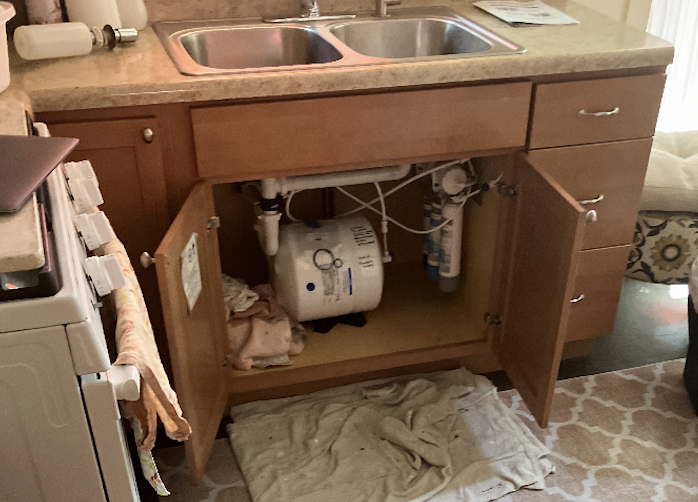
I struggled with this decision, in no small part because I viewed it as a capitulation to an industry that could care less about my health or that of any other Iowan. I also struggle with the fact that many millions of people around the world have life-long dysentery from drinking untreated and polluted water, and $800 might go a long way to correcting that, at least for one person or one family. But there it is, as you can see.
I wish the media would ask Reynolds and Naig if they drink tap water, not that I would expect them to answer honestly.
Here’s the bottom line on why this pollution exists and endures. Sale of nitrogen fertilizer in Iowa is a multi-billion dollar proposition, every year. Literally no one in the value chain wants that to change, and so almost no one in politics (of either party) wants that to change either. Koch Industries recently purchased one SE Iowa fertilizer manufacturing facility for $3.6 billion, if that tells you anything.
The scale of pollution that results from Iowa’s agricultural behemoth is so large and so widespread that the current corn/soy/CAFO system cannot be made to align with adequate water quality, at least with regard to nitrate. No reasonable person that has looked at this in detail can think otherwise. Farmers have been led to believe by the agribusiness establishment (and some in academia) that they need more nitrogen than what the scientific evidence supports and as such, are tenaciously resistant to regulation of nitrogen fertilizer, and everything else they buy for that matter.
To transition to a more sustainable production system that generates adequate water quality will require more crop diversity. With that, it is a certainty that adding crops to the current corn/soy rotation will result in reduced demand for nitrogen fertilizer and other inputs. There can be no doubt about that.
Iowa has allowed (and invited) livestock populations to get so incredibly large that a huge amount of corn acres is needed to dispose of all the manure because nothing else except perhaps potatoes will use the amount of nitrogen that corn does. As such, any reduction in corn acres will have to be accompanied by a shrinkage of either the livestock industry or commercial fertilizer industries. All that liquid hog manure has got to go somewhere, and any retreat in area planted to corn will effectively be the same as limiting nitrogen application rates. Something would have to give because the math is brutal and unforgiving. The Ag lobby will never let that happen until a critical mass of politicians can summon some courage to overcome them.
For this we’re sacrificing the health of Iowans.
Today anyway, I’m demoralized by the crop of Democrats currently holding political office. I said a couple of weeks ago that I would vote for Rob Sand if he was on the general election ballot. I’m not so sure of that today, after weeks of his declining to lead on this. Putting petty careerism above the health of the electorate is not something that inspires my advocacy or my vote. Would an interview of Rob Sand on this subject have sounded any different than the interview with Kim Reynolds? I doubt it.
I frequently wonder why the Democrats would even run a candidate for Secretary of Agriculture; their collective rhetoric on ag pollution and water quality is indistinguishable from Republican Mike Naig’s.
Austin Baeth, a Des Moines M.D. that’s in the legislature, appears to be the only person among currently elected officials with the courage to give this issue the voice it needs.
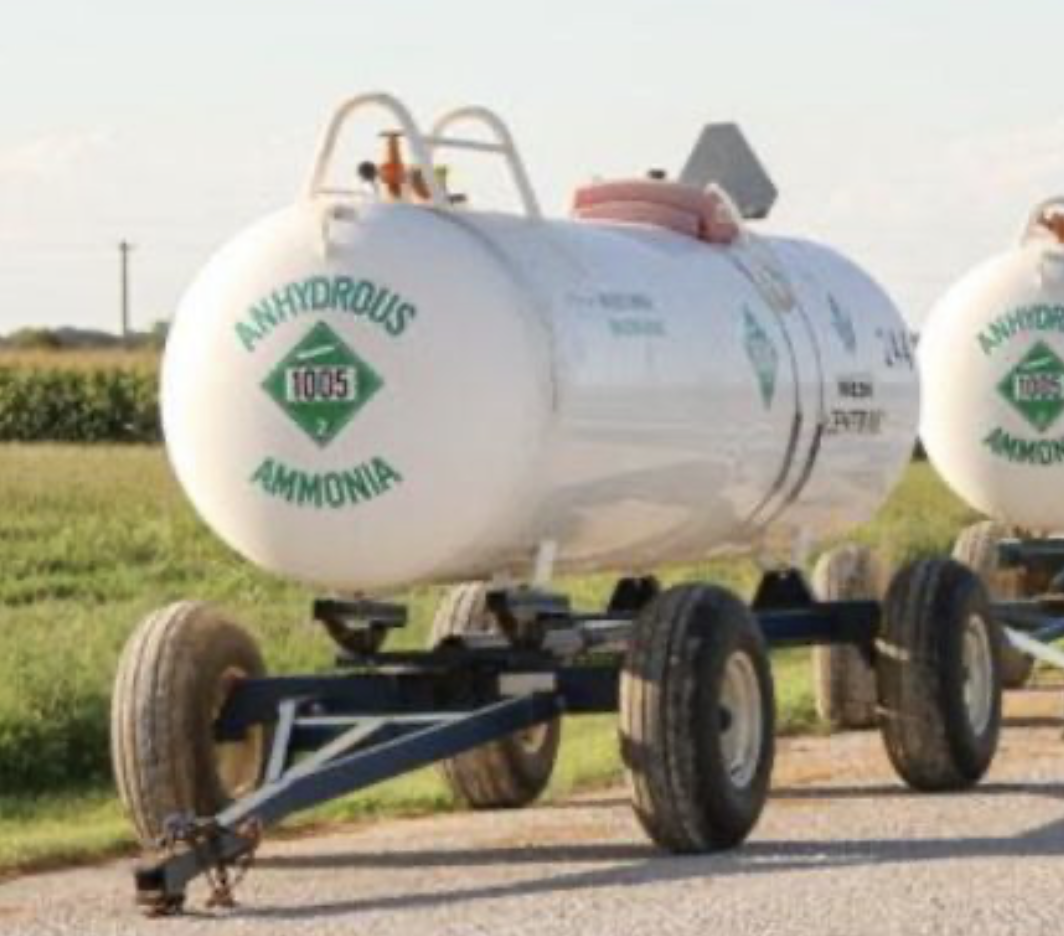
I calculated the amount of nitrogen traveling down some Iowa rivers over the past month (June), and converted it to the contents of those 1000 gallon anhydrous ammonia nurse tanks you see sitting in farmers’ fields when it is time to fertilize. That information is below.
Cedar River at Palo:
The contents of 5858 nurse tanks (20.4 million pounds of N) passed the town of Palo in the Cedar River in the month of June.
Raccoon River at Van Meter
The contents of 1950 nurse tanks (6.8 million pounds of N) passed the town of Van Meter in the Raccoon River in the month of June.
Des Moines River at 2nd Avenue in Des Moines
The contents of 4681 nurse tanks (16.9 million pounds of N) passed by the 2nd Avenue gauging station in Des Moines in the month of June.
Iowa River at Wapello
The contents of 5929 nurse tanks (20.7 million pounds of N) passed the town of Wapello in the Iowa River in the month of June.
Turkey River at Garber
The contents of 709 nurse tanks (2.5 million pounds of N) passed the town of Garber in the Turkey River in the month of June.
Other Resources
Stream nitrate and flows. USGS Streamflow for Iowa. https://waterdata.usgs.gov/state/iowa/
Animal populations, corn yields, corn acres. USDA NASS Quickstats. https://www.nass.usda.gov/Quick_Stats/
Animal populations. https://programs.iowadnr.gov/animalfeedingoperations/FacilitySearch.aspx
Nitrogen excreted by animals. https://iro.uiowa.edu/esploro/outputs/report/Nitrogen-and-phosphorus-budgets-for-Iowa/9984109997002771#file-0